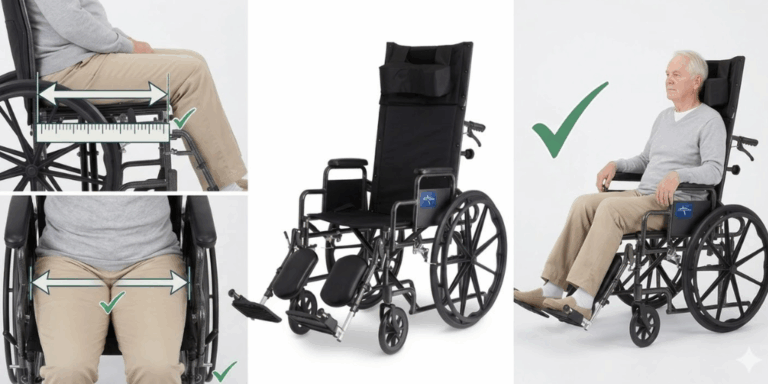
Standard vs. Ultra-Lightweight Wheelchairs: Which is Right for You?
Choosing the right mobility equipment is a decision that impacts every aspect of your daily life, from your physical independence to your long-term skeletal health. While a standard wheelchair may provide a basic solution for movement, an ultra-lightweight wheelchair is often a clinical necessity for active users who rely on self-propulsion. The primary difference lies in the engineering; by utilizing high-performance materials and adjustable geometry, these chairs transform the mechanics of mobility.
Understanding the technical distinctions between a standard steel-frame model and a precision-configured lightweight device is essential for ensuring you receive a chair that not only fits your home but also protects your body from the cumulative strain of daily use

Key Takeaways
- Propulsion Efficiency: Ultra-lightweight chairs require significantly less force to move, which is critical for users with limited upper-body strength.
- Joint Preservation: Reducing the weight of the chair is the most effective way to prevent repetitive strain injuries (RSI) in the shoulders and wrists.
- Customization vs. Fixed Design: Standard chairs offer a “one-size-fits-most” approach, while ultra-lightweight models are medically tailored to the user’s specific anatomy.
- Medicare Coverage: Both types are covered by insurance, but the ultra-lightweight wheelchair requires more detailed documentation regarding medical necessity.
Standard Manual Wheelchairs: Simple and Durable
Standard manual wheelchairs are typically categorized by their weight (usually over 35 lbs) and their durable, steel-frame construction. These are often considered “out-of-the-box” solutions.
- Best For: Individuals who need a wheelchair for short distances, part-time use, or those who are primarily pushed by a caregiver.
- The Limitations: Because these chairs have fixed components and a heavier frame, they can be exhausting for a user to self-propel over long periods.
- Insurance Aspect: When patients ask, “Does Medicare cover wheelchairs?”, a standard model is often the easiest to qualify for, provided you have a mobility deficit within your home
Ultra-Lightweight Wheelchairs: Performance and Health
An ultra-lightweight wheelchair (HCPCS code K0005) is often constructed from high-grade aluminum or titanium, bringing the weight down to under 30 lbs. Beyond weight, the true value of these chairs lies in their adjustability.
- Adjustable Center of Gravity (CoG)- Standard chairs have a fixed rear axle. Ultra-lightweight models allow the axle to be moved forward or backward. Optimizing the Center of Gravity makes every push stroke more efficient and reduces the strain on your shoulder joints.
- Specialized Biomechanics – These chairs allow for precise adjustments to seat-to-floor height and backrest angles. This ensures that the user is seated in a position that maximizes their reach to the wheels, further reducing the effort needed for daily mobility.
- Long-Term Clinical Protection – Propelling a lightweight wheelchair significantly lowers the cumulative force placed on the rotator cuff. For active users, this is the primary defense against chronic pain and the eventual loss of upper-body function.
To better understand the insurance process, you can read our detailed step-by-step guide on how to get a manual wheelchair covered by Medicare
Insurance and Medicare: Navigating the Choice
One of the most frequent questions we receive is: “Does Medicare cover wheelchairs in the ultra-lightweight category?” The answer is yes, but the documentation requirements are more stringent than for a standard lightweight wheelchair.
To qualify for an ultra-lightweight model (K0005), your physician and therapist must document:
- Failure of Standard Equipment: Why a standard or high-strength lightweight wheelchair is clinically insufficient for your needs.
- Home-Based Necessity: How the specific features of the ultra-lightweight chair allow you to perform activities of daily living (ADLs) inside your home.
- Specialized Configuration: The need for adjustable axle positions or specific seat-to-floor heights that only a K0005 model can provide.
FAQ: Standard vs. Ultra-Lightweight
Q1: How much lighter is a lightweight wheelchair compared to a standard one?
A: A standard wheelchair usually weighs 35–50 lbs. A high-strength lightweight wheelchair weighs between 30–34 lbs, while an ultra-lightweight model often weighs 20–30 lbs. This weight reduction is vital for both user propulsion and caregiver lifting.
Q2: Does Medicare cover wheelchairs if I only need them for outdoor use?
A: No. Medicare and most private insurance providers base coverage on “In-Home Medical Necessity.” The documentation must show that you need the chair to move between your bedroom, bathroom, and kitchen.
Q3: Is an ultra-lightweight chair less durable because it’s lighter?
A: Actually, it is often more durable. Ultra-lightweight chairs use aerospace-grade aluminum or titanium, which offers a higher strength-to-weight ratio than the heavy steel used in standard chairs.
Q4: Can a caregiver benefit from an ultra-lightweight design?
A: Absolutely. A lightweight wheelchair dramatically reduces the risk of back injuries for caregivers who frequently load and unload the chair into vehicles.
Q5: What is the most important feature for someone who pushes themselves?
A: The adjustable rear axle (Center of Gravity). Moving the axle closer to the user’s center of mass makes the chair feel “lighter” and easier to turn, significantly improving propulsion efficiency.